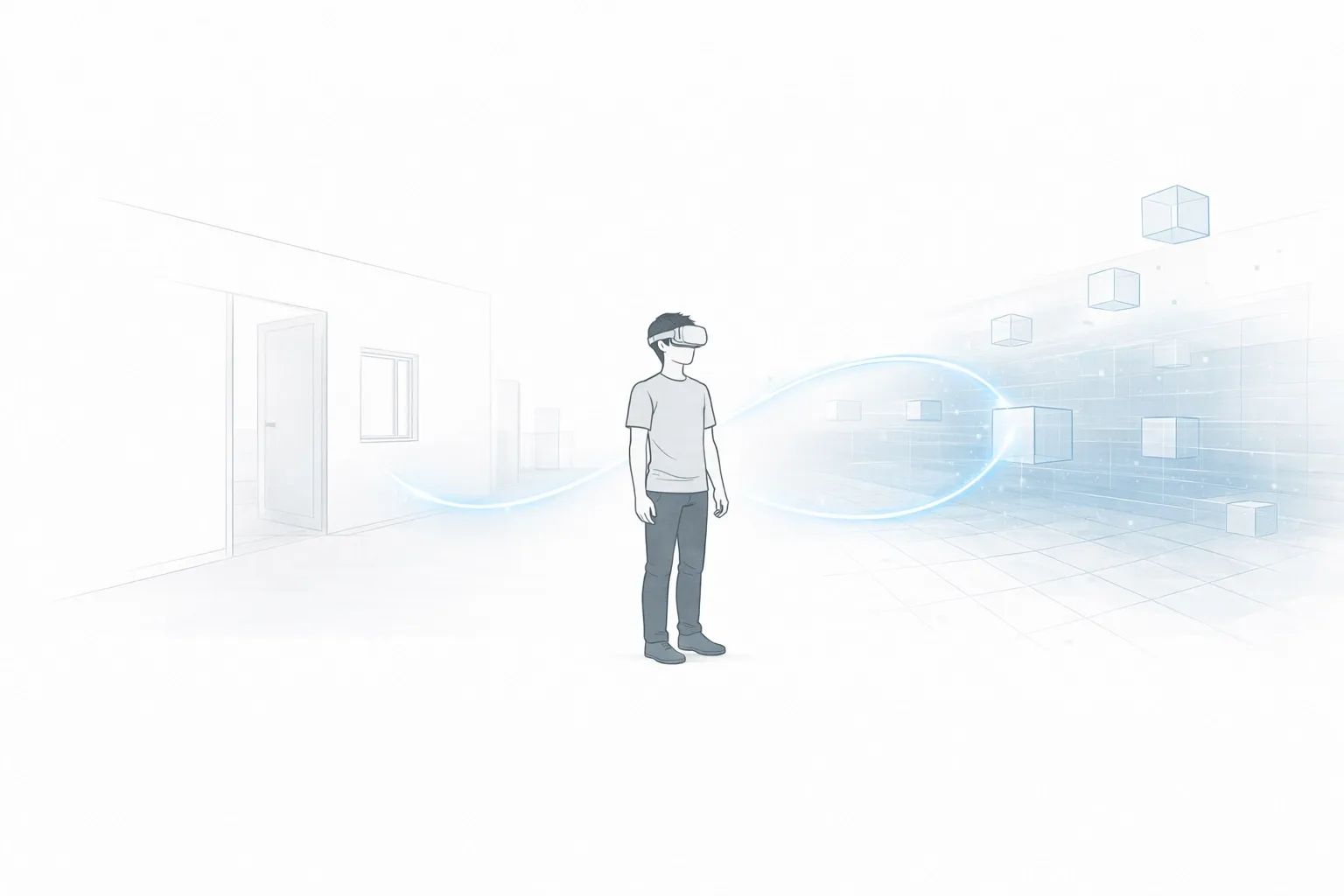
What Is Full-Dive? An Engineering Perspective on Full-Dive and Motion-Less VR
Introduction
Full-dive is generally described as a state in which a person is deeply immersed in an artificial world and can act without being strongly aware of the constraints imposed by the real body or real space.
What draws people to works such as Sword Art Online, The Matrix, and Ready Player One is not merely beautiful imagery, nor simply the number of sensory channels involved. What is portrayed as compelling is the experience of moving naturally within that world and having the results return as embodied feedback.
In actual discussion, however, phrases such as “connecting the five senses” or “connecting directly to the brain” often spread ahead of the underlying issue, making the essence harder to see.
This page re-examines full-dive as an engineering problem and organizes its core in terms of how far the loop between action and sensation can be established within an artificial world while reducing dependence on real-world constraints.
In our laboratory, we position Motion-Less VR as a technical approach for establishing that loop step by step.
Key Points
- The core of full-dive is not the number of senses involved, but how fully the loop between action and sensation is established within the artificial world.
- Output alone is not enough. The acquisition of motor intention, state changes on the artificial-world side, and the return of those results as sensation must form a single connected process.
- BCI/BMI is one promising candidate, but it is not itself the definition of full-dive, nor can it by itself solve the entire problem.
- Motion-Less VR is an approach that reduces dependence on real bodily movement while gradually shifting that loop toward the artificial-world side.
What makes full-dive compelling in anime and films?
Full-dive is often explained as “connecting the five senses.”
However, that phrase itself is not what is truly depicted as compelling in those works.
What is repeatedly portrayed is, for example, the following kind of experience:
- Being able to act without being obstructed by the walls or floor of a real room.
- Having the results of one’s actions return naturally as responses and feedback from that world.
- Having bodily changes and environmental changes within that world occur in a coherent and consistent way.
In other words, what matters from an engineering standpoint is not the phrase “five senses” itself, but how fully the loop between action and sensation is closed within that world.
Definition of Full-Dive
In our laboratory, we define full-dive as follows:
A state in which the loop between action and sensation is established within an artificial world while dependence on real-world constraints is minimized.
What matters here is how much of the preconditions for action and sensation still remain on the real-world side.
The more strongly an experience depends on a real room, real objects, or real bodily movement, the harder it becomes for that experience to be completed within the artificial world alone. Conversely, the more those dependencies can be reduced while establishing the loop on the artificial-world side, the closer the system comes to full-dive.
Why do real-world premises become a problem?
Full-dive becomes difficult when real-world constraints intrude into the experience of the artificial world.
Example 1: Spatial constraints
In an artificial world, one may be able to walk endlessly by design.
But in a real room, there are walls.
The moment one must stop in accordance with the real space, the experience is no longer closed within the artificial world alone.
Example 2: Constraints of objects and forces
Actions such as holding, pushing, and colliding involve real weight and real reaction forces.
The more real objects must be prepared, the more the experience is pulled back toward real-world conditions rather than remaining within the artificial world.
Example 3: Real-world-derived sensations
The tightness of a device, contact under the feet, contact from a seat, and the presence of cables are also real-world elements that intrude into the experience of the artificial world.
Even when they appear minor, they can weaken the feeling that the experience is being established within the artificial world itself.
Seen in this way, what matters for approaching full-dive is not eliminating all real-world constraints at once. Rather, it is to clarify which dependencies can be reduced, and to what extent, while expanding the range over which the loop can be established on the artificial-world side.
Five Evaluation Axes for Approaching Full-Dive
Full-dive is not something that appears all at once through a single great invention.
It is something approached only when multiple conditions come together.
On this page, we organize those conditions into the following five evaluation axes.
1. Reduce dependence on real bodily movement
The more extensively the real body must move, the more the experience is constrained by real space, physical capacity, and the range of motion of the body.
To approach full-dive, actions on the artificial-world side must be separated as much as possible from large-scale real bodily movement.
2. Reduce real-world-derived sensations
The stronger the sensations that are unrelated to the artificial world, such as tightness from a device or contact with the ground, the more easily immersion breaks down.
How far such interfering sensations can be suppressed is an important evaluation axis.
3. Acquire signals related to motor intention
What matters is not only the result of actual movement, but also how far one can acquire signals related to what the user is trying to do.
It is not possible to discuss full-dive while leaving the input side unspecified.
4. Establish changes in body and environment coherently on the artificial-world side
Given what the user is trying to do, it is necessary to compute consistently how bodily states and environmental states change on the artificial-world side.
If this breaks down, the experience as a whole does not hold together even if there is both input and output.
5. Return results to the body in a coherent way
It is necessary for the results of action to return naturally not only through vision and sound, but also through bodily sensation.
Even if the appearance is correct, if the bodily side is greatly mismatched, the loop is likely to break down.
These five are not separate problems arranged side by side.
Axes 1 and 2 mainly concern reducing dependence on the real-world side, while Axes 3 through 5 mainly concern establishing the loop within the artificial world.
What is often overlooked when thinking about full-dive are Axes 1 and 2.
What is often overestimated is Axis 5, especially the visual part of it.
Common Misconceptions
Misconception 1: If the senses are connected, one can move by intention
Returning sensation is not the same thing as moving an avatar.
To move an avatar as if it were one’s own body, it is necessary to acquire signals related to motor intention somewhere in the system.
Also, people do not feel that they have moved simply by seeing an image. The sense of movement becomes stable only when vision is aligned with tactile, muscular, joint, and vestibular sensations.
Misconception 2: If visual fidelity becomes high enough, we will be close to full-dive
Better visuals make an experience richer.
However, the essence of full-dive is not image quality itself.
As long as one must continue to move the real body substantially and remain subject to the constraints of a real room, the experience does not close within the artificial world.
Visual advancement is important, but it does not by itself constitute full-dive.
Misconception 3: Full-dive lies on a simple extension of full-body tracking
Full-body tracking is extremely important for advancing current VR.
However, it cannot be treated as identical to full-dive.
Methods that rely on actual bodily movement are intuitive, but for that very reason they depend on real space, real physical ability, and motions that are physically possible in the real body.
What full-dive aims at is to reduce that dependence as much as possible and to establish the loop within the artificial world.
Definition and Positioning of Motion-Less VR
In our laboratory, Motion-Less VR refers to:
a technical approach that suppresses real bodily movement as much as possible, reads signals related to motor intention from the body surface and related sources, and returns the results as sensory feedback, thereby gradually establishing the loop between action and sensation within the artificial world.
The key point of this approach is that it does not assume BCI/BMI alone as its premise.
What it emphasizes is gradually reducing the real-world premises that remain while expanding the range of experience that can be established on the artificial-world side.
Viewed in relation to the five evaluation axes, Motion-Less VR is positioned as an approach that particularly advances the reduction of dependence on real bodily movement, the acquisition of signals related to motor intention, and the return of results to the body.
For that reason, the value of Motion-Less VR becomes difficult to see if one assumes that “full-dive equals the brain” or that “it is enough simply to add sensations.”
What matters is that it handles both input and output while gradually expanding the artificial-world loop.
Direct Brain Connection Is a Promising Candidate, but It Is Not the Definition of Full-Dive
In discussions of full-dive, BCI/BMI is often treated as the ultimate solution.
Indeed, in the direction of further reducing dependence on real bodily movement, directly handling brain signals is a promising candidate.
However, in our laboratory’s view, the essence of full-dive does not lie in reading directly from the brain itself.
What matters is that the loop between action and sensation is established within the artificial world while dependence on real-world constraints is minimized. In that sense, BCI/BMI is one promising technology that can support that loop, but it is not itself the definition of full-dive.
At the same time, current BCI/BMI has not yet reached the stage where it can support full-dive as it is.
Invasive approaches can handle more detailed information, but they still involve issues of surgery, maintenance, and long-term stability. Non-invasive approaches are easier to use, but the signals tend to be coarser, and the burden of calibration and adjustment remains.
For that reason, what has been realized so far is mainly progress in individual functions such as finger control, cursor control, speech decoding, and limited sensory feedback.
These are important advances. However, there is still a large gap between such progress and full-dive in the sense of handling the whole body naturally and stably as one’s own body while continuously returning rich sensations.
In this sense, BCI/BMI is an important candidate for moving toward full-dive, but at least for the foreseeable future it cannot be regarded as a technology that solves the entire problem by itself.
In our laboratory, we position it within a broader set of technologies that also includes bodily signal acquisition and sensory feedback, all aimed at reducing real-world constraints step by step.
It Should Be Understood as a Continuum, Not a Binary 0/1
It is more appropriate to think of full-dive not as a simple binary of “achieved” or “not achieved,” but in terms of how far dependence on real-world constraints has been reduced.
Whether one measures muscle signals or brain signals, both are similar in that they deal with some kind of real-world signal.
The difference lies in which constraints can be reduced, and to what extent.
What matters is not only what is being measured.
What matters is how far dependence on a real room, real objects, real bodily movement, and real-world-derived sensations can be reduced, and how far the range over which the loop can be established within the artificial world can be expanded.
In our laboratory, we understand full-dive as this kind of continuous progression.
Is Full-Dive Feasible?
In conclusion, full-dive is fully discussable as a research theme with real feasibility.
That said, it is difficult to imagine that the complete form depicted in science fiction will suddenly appear exactly as shown.
On the other hand, in the sense of gradually reducing dependence on real-world constraints and expanding the loop between action and sensation within the artificial world, full-dive is a realistic research problem on the scale of decades.
What matters here is not gathering expectations around magical-sounding words.
What matters is evaluating technological progress by asking which of the five axes have been satisfied and which still remain.
FAQ
Q1. Is full-dive VR like in anime and science fiction feasible?
A. Its feasibility can be discussed seriously. However, it is unlikely to appear all at once as a magical technology. Rather, it is something approached step by step as multiple elements are gradually integrated.
Q2. Why is body-movement-based VR hard to call full-dive?
A. Because actions still depend strongly on real space and real objects, the experience does not close within the artificial world.
Q3. What is Motion-Less VR?
A. It is a technical approach that suppresses real bodily movement, acquires signals related to motor intention, and returns the results as sensation, thereby gradually establishing the loop between action and sensation within the artificial world.
Q4. Does full-dive have to rely on direct brain connection?
A. Not necessarily. BCI/BMI is a promising candidate, but the essence of full-dive is not direct reading from the brain itself. It lies in minimizing dependence on reality while establishing the loop between action and sensation within the artificial world. Moreover, current BCI/BMI is still at the stage of advancing functions such as finger or cursor control, speech decoding, and limited sensory feedback, and has not yet reached the point where the whole body can be handled naturally and stably. For that reason, direct brain connection is important, but it should not be equated with full-dive itself.
Q5. Why are bodily sensations important in addition to vision?
A. People do not feel that they have moved simply by seeing an image. The sense that one has moved becomes stable only when vision is aligned with tactile, muscular, joint, and vestibular sensations. Even if the visual scene is correct, if resistance and kinesthetic sensations are missing, the act itself is likely to feel thin and less real.
Q6. Why should full-dive be considered as a continuum rather than a binary 0/1 state?
A. Because the issue is not whether one is completely cut off from reality, but how far dependence on real-world constraints has been reduced. We regard full-dive as something approached continuously.
Conclusion
Full-dive cannot be adequately explained by phrases such as “technology that connects the five senses” or “technology that connects directly to the brain” alone.
Its essence lies in how far the loop between action and sensation can be established within the artificial world while reducing dependence on real-world constraints.
For that reason, multiple elements must be considered separately, including dependence on real bodily movement, real-world-derived sensations, the acquisition of motor intention, state changes on the artificial-world side, and the sensory return of results.
BCI/BMI is an important candidate within that broader picture, but it cannot be identified with full-dive itself.
Motion-Less VR is an approach for gradually satisfying those conditions in a realistic way.
We hope this page serves as a foundation for organizing common misunderstandings about full-dive and for thinking about a roadmap toward its realization.